
The aspect you overlooked is causing the ruin of your coffee beans priced at 100 yuan per pound.
At 7:45 a.m. on Monday, Li Ming poured the freshly baked Kenyan AA coffee beans into the small electric grinder that had been by his side for three years. He turned on the switch, and a sharp “zing” sound pierced the tranquility of the early morning. After 30 seconds, he poured out the powder – some were as fine as flour, while others were as coarse as sugar cane fibers.
The hot water poured down, the sour taste stung the throat sharply, and the bitter taste was heavy and burnt.
“Why did it fail again? It was clearly a high-quality bean.” He sighed and added two cubes of sugar before swallowing them.
This is not a technical issue. This is a long-neglected fact: Before having a cost-effective coffee bean grinder, what you were drinking was always “unevenly extracted” bitter water, rather than the original flavor of coffee.
Today, we won’t discuss metaphysics. Instead, we will only talk about the physical structure, grinding dynamics, and thermal protection mechanisms. At the end of the article, I will also tell you a “hidden defect point” that most evaluations won’t mention – it might be the fundamental reason for the inconsistent performance of your coffee maker.
I.Why is your espresso always lacking that final touch? Uniform grinding is the first line of defense.
According to the standards of the Specialty Coffee Association (SCA), a qualified espresso shot requires an extraction time of 25-30 seconds. However, without an affordable coffee grinder, if the particle distribution deviates by more than 20%, fine powder will clog the filter holes, while coarse powder will over-extract.
This means: If you purchase beans at 100 yuan per pound, you might only be able to extract the value of 30 yuan from them.
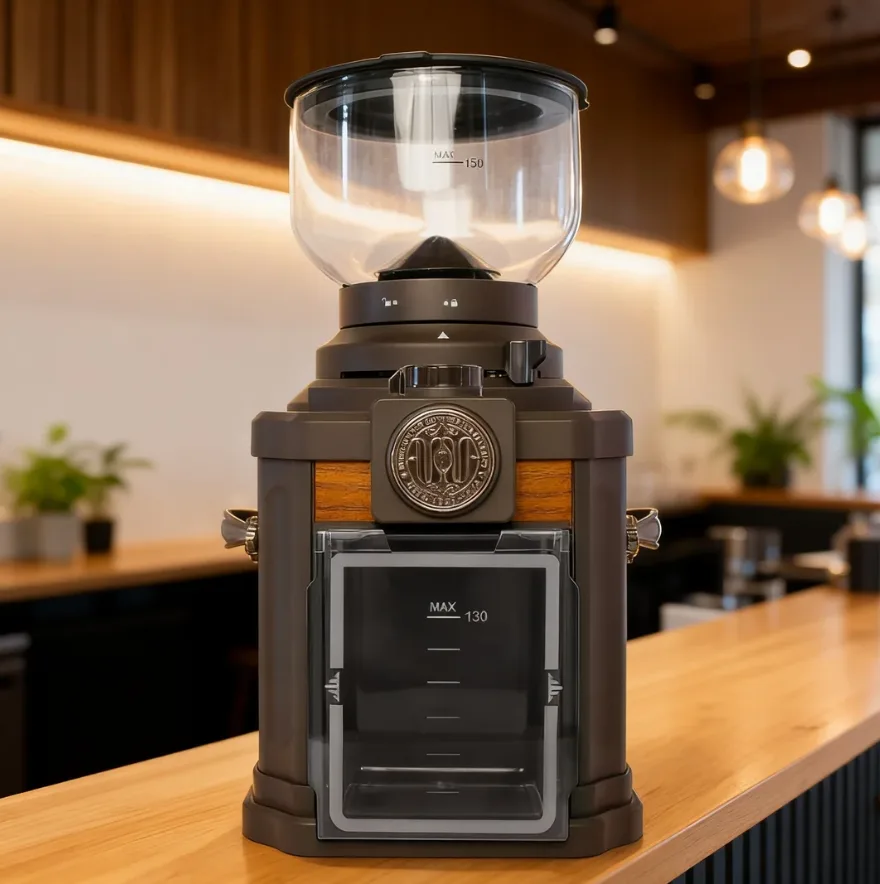
1.1 Core Hardware: Stainless Steel Conical Grinding Blade
Many low-priced models on the market use flat blade discs, which result in low cutting efficiency and high heat generation, causing the coffee powder to oxidize prematurely.
Our solution employs high-performance and highly abrasive stainless steel conical grinding heads. The conical structure has two key advantages:
-
- Progressive crushing: The beans enter from the top and are gradually crushed instead of being cut off with one stroke. This reduces the generation of fine powder.
-
- Low rotational speed and high heat capacity: The stainless steel material has slow heat conduction, resulting in a temperature rise of 8-10°C lower than that of the flat cutter disc during grinding.
Success Case: The independent coffee shop “Xianli” in Shenzhen previously used an imported entry-level electric grinder. The concentration flow rate was unstable, sometimes fast and sometimes slow. After the store manager replaced it with our economic coffee grinder suitable for espresso coffee, during the extraction rate test (using the VST filter bowl), the deviation of TDS (total dissolved solids) in the same parameters for 5 consecutive cups was reduced from ±0.8% to ±0.2%. Their monthly coffee bean loss has now decreased by 12%.
1.2 16-level grinding: From French press to Turkish coffee
Not all grinders can achieve a clear distinction between coarse and fine. Our machine offers 16 levels of grinding functionality:
| Gear range | Applicable scenarios | Particle diameter reference |
| 1-4 gears | Turkish coffee, Italian espresso | Ultrafine (<300 microns) |
| 5-8 gears | Moka pot, hand brewing (cone filter) | Medium-fine (300-500 microns) |
| 9-12 gears | Hand brewing (flat-bottom filter), Aeropress | Medium-coarse (500-1000 microns) |
| 13-16 gears | Pour-over, cold brewing | Coarse (>1000 microns) |
This gear density allows you to have extremely high resolution when adjusting the extraction scheme. Even the best budget coffee grinders usually only have 10-12 gears.
1.3 Visualized Grinding Process: Transparent High-Boron Glass Window
This is a design that is often overlooked but extremely practical. During the grinding process, the beans may “arch” (i.e., spin but not fall into the hopper). Through the transparent heat-resistant high-boron glass viewing window, you can directly observe the falling of the beans, avoiding the grinding chamber spinning and damaging the cutter head.
II. Dimensions and Capacity: The Golden Ratio Designed for Home Bar Counter
Many coffee enthusiasts complain that the grinder takes up too much space or can’t produce enough coffee for two people at a time.
2.1 Compact Body: 168*178*275mm
How small is this size? It is narrower than a regular household juicer. You can easily place it in:
-
- The corner of the kitchen countertop
-
- The second layer of the sideboard
-
- Even hung on the wall (with anti-slip feet at the bottom)
The weight is only 1.8KG and it can be moved with one hand. This is the typical design philosophy of small and economical coffee grinders – without sacrificing performance, only reducing the size.
2.2 Separate Double Containers: 130g bean container + 110g flour container
Here is a hidden efficiency point:
-
- Coffee bean supply container (130g): Approximately equivalent to the amount of beans needed for 15-18 cups of espresso. Sufficient for a week’s household usage and will not cause the beans to oxidize due to long-term storage.
-
- Coffee powder container (110g): Fully transparent, detachable.
The most crucial point is that the coffee bean supply barrel and the coffee powder container are separable. This means:
1、You can change the type of beans at any time without having to empty the entire machine.
2、The powder container can be used directly as a powder collection cup. When placed in the hand-held powder bowl, it can reduce the waste of powder flying out.
III. Safety and Quietness: The Key Factors Affecting How Long a Machine Can Serve You
The most common cause of failure for electric grinders is not the motor burning out, but overheating and improper cleaning.
3.1 Triple Safety Measures: More Than Just a Marketing Ploy
We have implemented three layers of physical protection:
-
- Overvoltage protection: The power supply will automatically shut off when the voltage exceeds the rated value by 10%. This prevents the mainboard from being damaged due to unstable voltage in old residential areas.
-
- External temperature protection: The device automatically shuts down when the shell temperature reaches 280°C. This is an extremely high threshold to ensure that even in the event of an internal short circuit, the shell will not catch fire.
-
- Internal temperature protection: When the temperature of the PCB motherboard reaches 216°C, the circuit will be automatically cut off to protect the core control chip.
The combination of these three factors means that even if you grind 1 kilogram of beans continuously (though it is not recommended), the machine will not suddenly “crash”.
3.2 Silent Design
-
- Silent Grinding: The actual measured working noise is below 60 decibels. This is equivalent to the volume of normal conversation, much lower than the 75-85 decibels of ordinary electric grinders (close to that of a vacuum cleaner).
IV. In-depth Analysis of Successful Cases: From “Occult” to “Controllable”
Case: The Upgrading Journey of Family Player Mr. Chen
Mr. Chen has been playing the game for 3 years. He has used bean-scratching machines, hand-cranked grinders, and a certain domestic 200-yuan electric grinder. His biggest problem is: for the same bean and the same grinding setting, it was delicious yesterday but not so good today.
The problem lies in the thermal accumulation and the axial vibration of the cutter head. The cutter heads of cheap electric grinders will oscillate up and down during high-speed rotation, causing the fine powder rate to soar as the temperature rises.
We suggested that he switch to this economical coffee grinder which is most suitable for home use. A week later, he sent us the data:
-
- Use the C40 hand-powered mill as the benchmark (with a fine powder rate of 5.2%).
-
- After continuous grinding for 5 cups, the fine powder rate of our electric grinder stabilized at 5.5% – 5.8%.
-
- The old electric grinder had a fine powder yield of 9.3% by the third cup.
Mr. Chen’s exact words were: “Finally, I can taste the flavor of Kenyan cherry tomatoes now, instead of the ‘tomato sauce’ flavor before.”
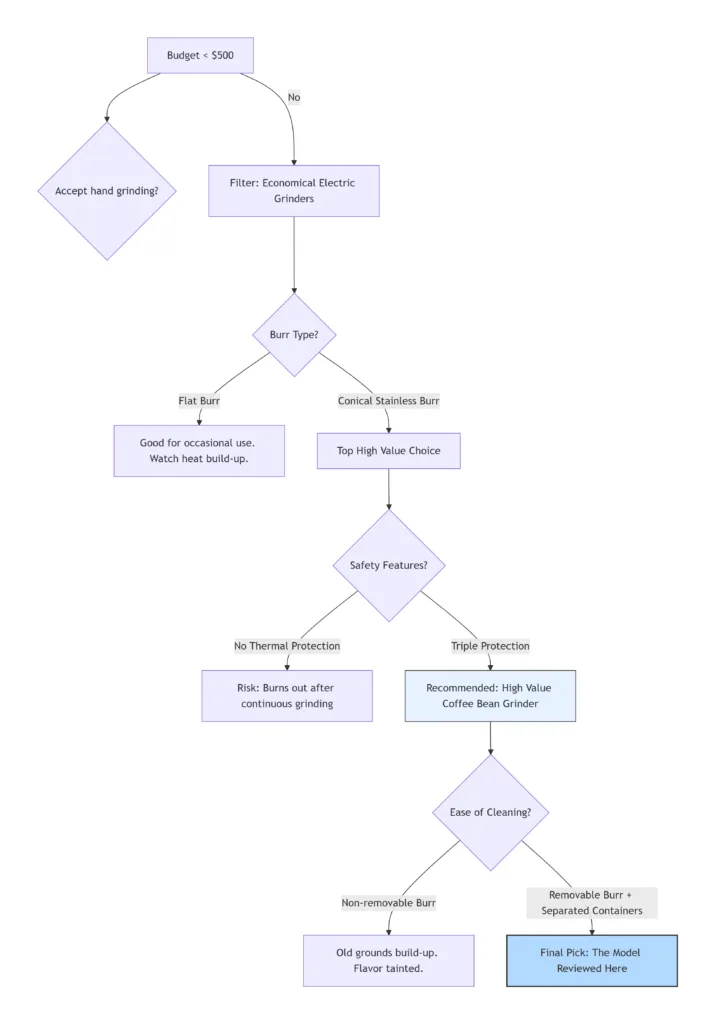
V. Infographic: The Decision-Making Path for Selecting Cost-Effective Coffee Bean Grinders
VI. Concealing Critical Information: The majority of reviews will not reveal the “chronic death” issue to you.
Now, I will show you the “hidden flaws” that were promised at the beginning of the article.
If you look at the parameter page of any economical electric coffee grinder available on the market, you will see words like “xx adjustable settings” and “xx gram capacity”. But 99% of the reviews won’t tell you:
Hidden Point: Used Powder is the “Flavor Killer”
For almost all non-detachable grinding heads, there will be 2-5 grams of aged residual powder permanently stuck in the gap between the blade disc and the body of the machine. These powders will oxidize when exposed to air, absorb moisture, and develop an unpleasant odor.
Consequence: The Ethiopian Yirgacheffe coffee you ground today actually tastes like the burnt flavor of last week’s dark-roasted Muntinink.
Our solution: The shredding blade (upper part) operates in a separate mode, combined with a cleaning brush, and can completely clear all residual powder within 30 seconds. Each cup offers a pure and distinct flavor.
Conclusion: Your next grinder should not be a gamble
We have disassembled the 16-step functionality, the triple protection redundancy design, the compact 1.8KG size.
You don’t need to spend extra money on a mini version of a commercial machine, nor do you need to endure the random chopping of the bean grinder.
A truly cost-effective coffee bean grinder should be able to: allow you to see the grinding process, hear the quiet operation, disassemble all the leftover powder, and never overheat and shut down at critical moments.
You are just one consultation away from having a stable, clean and well-structured cup of coffee.Click to inquire now!